
NEURO MARKETING
What is neuromarketing?
Neuromarketing is the study of how people’s brains respond to advertising and other brand-related messages by scientifically monitoring brainwave activity, eye tracking and skin response.
These neuromarketing techniques are used to study the brain to predict consumer decision-making behavior. It’s also possible to use neuromarketing to try to manipulate consumer behavior.
Marketers use neural and other physiological signals to gain insight into customers’ motivations, preferences and decision-making processes. They also use this research to predict how a particular product, service or marketing campaign will perform.
What is neuromarketing used for?
Neuromarketing is used in a variety of ways. In 2007, a team of scientists from Carnegie Mellon University, Stanford University and the MIT Sloan School of Management used functional magnetic resonance imaging (fMRI) to study what peoples’ brains do when they are making buying decisions. By using brain imaging to watch which neural circuits lit up or went dark during the buying process, researchers found they could predict whether a person would buy a product.
The results of neuromarketing research can be surprising. In his 2008 book, Buyology: Truth and Lies About Why We Buy, Martin Lindstrom documented a three-year study, starting in 2004, that included the following findings:
- Warning labels on cigarette packages stimulate neural activity in an area of the brain associated with craving — despite the fact that subjects said that they thought the warnings were effective.
- Images of dominant brands, such as the iPod, stimulated the same part of the brain that religious symbols activate.
- An image of a Mini Cooper activated the part of the brain that responds to faces.
Some ways neuromarketing is used include the following:
- product design testing;
- user experience testing;
- A/B testing to compare the effects of similar ads;
- optimizing a call to action, such as “Visit our website”;
- assessing the neural impact of images in an advertisement; and
rebranding campaigns.
Neuromarketing research is expensive for companies to conduct themselves because neuro technologies are expensive and specialized. They often hire neuromarketing consulting firms to conduct this specialized research.
Benefits of neuromarketing
There are many benefits of neuromarketing, including the following:
- Granular insight. Neuromarketing provides a more granular look at human behavior than traditional market research, which evaluates consumer behavior at a higher level using techniques such as surveys and focus groups. Neuromarketing strategies take a precise look at consumer behavior, preferences and tendencies. They use data that is otherwise unquantifiable data to determine how a customer is feeling or how they might react. Neuromarketing can also provide moment-by-moment insights into customer behavior.
- Honest feedback. Because customers cannot lie in a neuromarketing context, these methods generate more reliable data. Just asking a person how they feel about something can change their feelings. Neuromarketing bypasses this problem, generating objective results that a traditional customer satisfaction survey cannot provide.
- Subconscious revelations. The approach can reveal insights into the subconscious mind, and short responses that people generally do not remember.
- Cost effective. Neuro marketing can lower the price and increase the value of marketing research.
- Holistic strategies. Neuro marketing is paired with traditional methods for a more holistic approach to marketing research.
Criticisms of neuro marketing
Critics of neuro marketing warn of a variety of dangers, including these three:
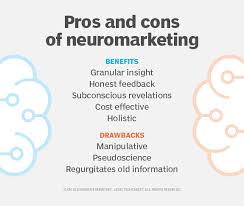
- Manipulative. Anti-marketing activists, such as Gary Ruskin, executive director of U.S. Right to Know, warn that neuro marketing could play on consumers’ fears to manipulate them or encourage specific neural responses to stimuli. Marketers insist that such precise manipulation is not possible or desirable. According to BrightHouse, an Atlanta consulting firm, neuro marketers aim to understand how and why customers develop relationships with products, brands and companies.
- Pseudoscience. Neuro marketing is often conflated with pseudoscience and hype, and is not backed by credible neuroscientific claims. Critics like University of Pennsylvania professor Joseph Turow have dismissed it as a gimmicky way for marketers to gain insight into consumer opinion.
- No new information. Critics charge that neuro marketing uses science to explain in a more complex way what could be deduced using intuition. They say it simply validates things marketers already know about consumers.
Neuro marketing tools and measurement
Neuro marketing typically measures brain activity and other physiological signals. Two tools used for brain scans are the following:
- An fMRI tracks blood flow with continuous measurements. It is precise and a good tool for tracking activity deep in the subcortical regions of the brain.
- An electroencephalogram (EEG) uses sensors placed on subject’s scalp to track changes in brain activity. It is useful for tracking brain activity quickly, in fractions of a second. And while an EEG is less precise than an fMRI, it is generally less expensive. FMRIs cost millions of dollars, while EEGs cost tens of thousands.
There are also tools for measuring physiological proxies for brain activity. Some examples of these tools include the following:
- Eye tracking records where a person fixes their gaze for a certain amount of time, indicating heightened interest on the fixation point.
- Arousal is measured by specific physiological proxies and biometric data, including heart rate, respiration rate, skin conductivity and pupil dilation.
- Facial coding involves reading the subtle muscle movements of a person’s facial expressions to gauge their emotional response to something and perform sentiment analysis…..